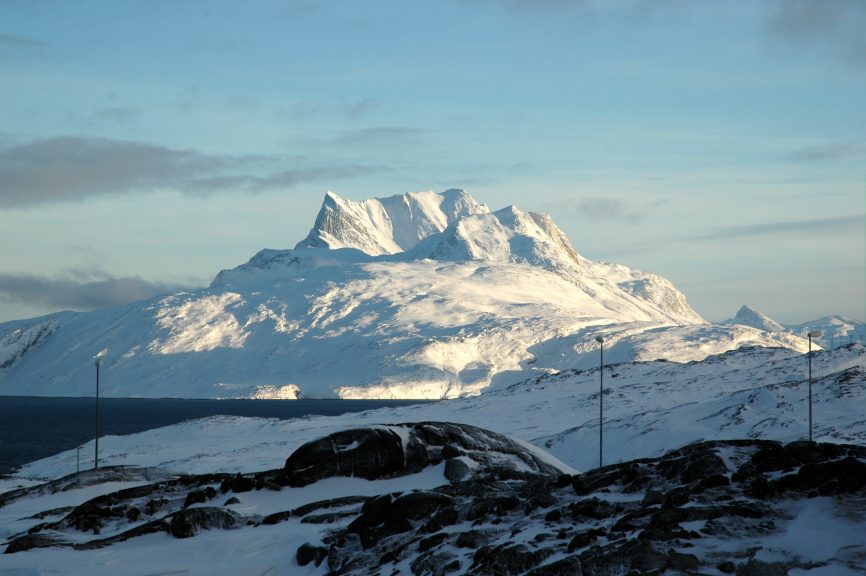
Glacier Kangiata Nunâta Sermia in West Greenland. Photo: Peter Schmidt Mikkelsen
Service of GPS-equipment at the Greenland Ice Sheet.
GPS-equipment for measuring the Greenland Ice Sheet.

Glacier-fjord-ocean


Collaborative Research:Quantifying Glacier-Fjord-Ocean Interactions and their Impact on Changing Ice Discharge: Kangiata Nunâta Sermia and Other Outlets, West Greenland. A NSF financed program.

This multidisciplinary proposal aims to improve understanding of ocean/glacier-ice interactions by linking oceanographic, glacier, and atmospheric measurements in a fjord/glacier system showing recent change to quantify processes occurring at this interface. The proposed work leverages and extends a substantive oceanographic investigation established as part of a Greenlandic-Danish IPY initiative, FRESHLINK, which attempts to assess the freshwater balance of the Godthåbsfjord drainage in southwestern Greenland. This proposal adds tightly integrated glacier and inner-fjord components to this multidisciplinary effort.

The specific goals are to 1) establish observations of glacier flow variability and patterns of change of the main glacier entering the fjord and quantify ice discharge on seasonal and annual time scales and relate these to fjord and off-shore oceanographic measurements; 2) quantify submarine melting at the calving terminus as a function of water temperature and glacial freshwater discharge; and 3) compare these results to other outlets and assess the implications for glacier-ice/ocean interaction on the scale of Greenland.

The underlying assumption, that oceanographic forcing controls aspect of outlet glacier flow, is suggested in many areas of Greenland. Understanding recent outlet glacier retreat requires a study of the entire glacier-fjord-open ocean system. Such an integrated approach is the goal of this proposal. The combination of detailed seasonally-distributed oceanographic transects with measurements from moorings will allow quantification of marine melting of glacier ice as well as subglacial discharge. The suite of glaciological measurements will quantify the response of the glacier system as well as constrain surface melting. The satellite time series of the system, analyzed with the goal of finding remotely measurable characteristics that scale with the processes measured in situ, may allow extension to other fjords around Greenland.


Characterizing freshwater and heat fluxes inside the Godthåbsfjord

The Godthåbsfjord is ca. 186 km long covers 2000 km2 and has an average depth of 260 m. The fjord has several branches and is connected to the Greenland Ice Sheet via glaciers in the innermost parts. Cold surface water originating from the East Greenland Current, and a deeper water mass consisting of warm and more saline Irminger water characterizes the hydrography on Fylla Bank outside the fjord.

A long-term marine monitoring program (Marine Basic Nuuk) was initiated in the area in 2005 and has collected data throughout the year since then. A distinct freshwater signal is present in the surface water in the inner parts of the fjord, clearly highlighting the freshwater input from land that moves towards the sea as a freshwater layer in the surface. Moorings have been deployed in the outer parts of the Godthåbsfjord to quantify the exchange of water between the fjord and offshore waters. In addition, two moorings have been be mounted by divers at protected sites further inside the fjord by the research project FRESHLINK run by Greenland Climate Research Centre. These moorings are situated 80 km from the glacier front of Kangiata Nunâta Sermia. They provide continuous reading of current (HADCP), salinity, temperature and pressure (CTD).

In this project existing FRESHLINK measurements will be extended farther into the Godthåbsfjord. More temperature, salinity and current data will be collected in the inner part of the Kangersuneq fjord close to the Kangiata Nunâta Sermia glacier.

CTDs and current meters (RCM09) will be deployed during winter through holes drilled in sea ice. Furthermore, continuous measurements of salinity and temperature in the upper 10 m closer to the glacier front will be provided by a moored CTD (SBE37+) placed by divers in an ice protected site. Periods of open-water occur frequently and this can be monitored on MODIS imagery. During such times CTD and ADCP measurements will be perform from a small research vessel as close to the glaciers as possible. During this time we will also collect more bathymetric information and added to the existing 3D model of the rest of Godthåbsfjord.

Contact: Martin Truffer, Associate Professor of Physics
E-mail: truffer @ gi.alaska . edu

Geophysical Institute 
University of Alaska Fairbanks
P.O. Box 757320
Fairbanks AK 99775


Opdated 07.14.2010